

Last modified on:
Superstition isn’t just folklore – it’s quietly reshaping the world’s buildings, floor by floor and room by room.
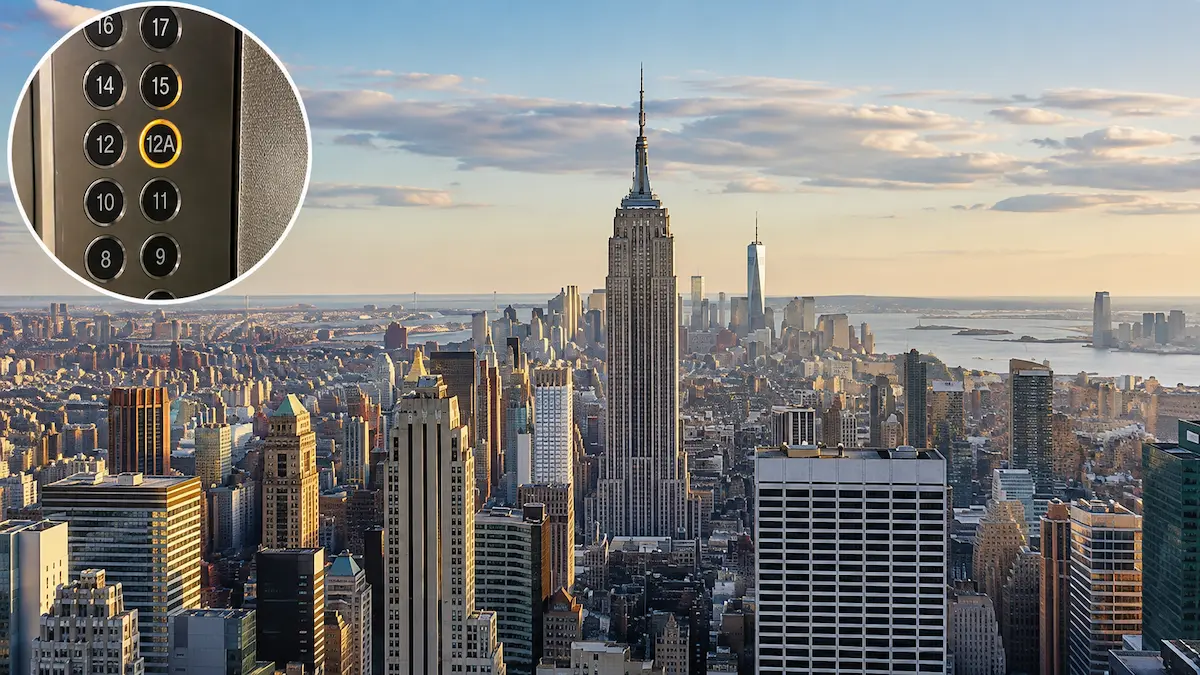
According to a 2020 StreetEasy study, only 9% of New York City’s residential high-rises taller than 13 storeys actually label a floor “13”. The rest jump straight from 12 to 14, rename it “12A”, or quietly turn it into a storage level. Otis Elevator, one of the world’s largest lift manufacturers, estimates the number is missing from around 85% of the elevators it installs across the country.
It’s a pattern developers have followed for over a century, and it isn’t going away – but New York’s missing 13th floor is only half the story. Thousands of miles away, in cities across East Asia, an entirely different number is being erased from buildings altogether.
“It’s easy to write this off as old superstition, but it’s still actively shaping how buildings get numbered today, on opposite sides of the world, for completely different reasons. That’s what makes it such a fascinating study in how deep-rooted these beliefs really are.”
— Spokesperson for McLuck
A missing floor, hiding in plain sight
The fear of the number 13, known as triskaidekaphobia, has shaped Western architecture for well over a hundred years. A 2007 Gallup poll found 13% of Americans said they’d feel uneasy staying on a hotel’s 13th floor – a small enough figure that, for developers weighing the cost of alienating even a fraction of buyers, skipping the number altogether became the simpler option. It isn’t just floors, either: some studies suggest apartments that do carry the number 13 sell less often than equivalent units on other floors.
Half a world away, it’s a different number
Across China, Japan, South Korea, Hong Kong and Vietnam, it’s the number four that vanishes from buildings – a superstition known as tetraphobia. In Mandarin and Cantonese, four is pronounced almost identically to the word for “death”, and the association is taken seriously enough that hospitals in the region routinely skip the 4th floor entirely, along with room numbers like 4, 14 and 24.
In Hong Kong, the superstition is often combined with the West’s fear of 13: some high-rises jump straight from the 39th floor to the 50th, erasing every floor number that contains a 4 or a 13 in one go. In Japan, hospitals also avoid room numbers 9 and 43, which sound like the words for “suffering” and “stillbirth” respectively.
Why a made-up number still moves markets
What’s striking is that none of this is enforced by any rule – it’s demand quietly shaping supply. Developers aren’t superstitious themselves; they’re pricing in the fact that enough buyers are. As one New York developer put it when explaining the decision to skip 13 in his own building, if there’s even a small risk a number puts buyers off, it isn’t worth the fight. The same commercial logic plays out in Hong Kong hospitals and Detroit hotels alike: it costs nothing to leave a number out, and it can cost sales to leave it in.
We have conducted fresh research which has also mapped which specific numbers are considered lucky and unlucky around the world, and why – from Greece’s affection for three to China’s obsession with eight.
The world’s lucky and unlucky numbers, country by country
| Country | Lucky number | Unlucky number |
|---|---|---|
| China | 8 | 4 |
| Japan | 7 | 4 / 9 / 43 |
| South Korea | 3 | 4 |
| Vietnam | 9 | 4 |
| Thailand | 9 | 6 |
| India | 9 | 26 |
| Afghanistan | 7 | 39 |
| UK | 7 | 13 |
| Italy | 13 | 17 |
| Germany | 4 | 13 |
| Spain | 7 | 13 |
| Greece | 3 | 13 |
| USA | 7 | 13 |
| Mexico | 7 | 13 |
Source: McLuck analysis of Google Keyword Planner search volume data, normalised per 100K population by country.
In the West, seven is regarded as the number that brings good fortune, while thirteen is believed to be unlucky by most – unless you’re Italian, in which case 13 is famously associated with hitting life-changing jackpots.
In Asia, nine is the number people idolise, tied to destiny and longevity, while China’s own lucky number, eight, is pronounced ‘bā’ – close to ‘fā’, meaning to prosper. Indians consider 26 unlucky due to several historical tragedies falling on that date, and South Koreans favour three, seen as perfectly balanced between beginning, middle and end.
Methodology & sources
- Figures on New York’s missing 13th floor are drawn from a 2020 StreetEasy analysis of 629 residential buildings taller than 13 storeys, and from Otis Elevator’s public estimate of the share of its US elevators without a 13th floor button.
- The Gallup statistic on hotel guest discomfort is from a 2007 Gallup poll.
- Information on tetraphobia and numbering practices in East Asia was collected from multiple reliable published sources.
- The country-by-country lucky and unlucky number data and search volumes were collected by McLuck using Google Keyword Planner, using data from the past year, and converted into per 100K population for each country to draw fair comparisons between countries of differing size.
Other Articles:
More Fun Facts

Things to Do on Labor Day Weekend (Fun Ideas for 2026)
Labor Day weekend is the unofficial end of summer. It is a time to relax, enjoy time with family and friends, and make the…

10 Fun Facts About Labor Day in the USA
Long weekend unlocked, finally! Between parades, cookouts, and last-chance summer adventures, Labor Day is all about celebrating the people who keep America ticking. Whether…

12 Fun Things to Do on 4th of July: 2026 Ideas for Every Kind of Celebration
Some holidays come with rules. The 4th of July mostly comes with one: have a good time, however that looks for you. Go big…
Is It Better to Play Max on Slot Machines?
If you have spent any time around slot players, you have probably heard it: always play max coins, it gives you better odds. It…
How to Get Free Spins at McLuck: A Complete Guide
If you are searching for McLuck free spins, you are likely looking for ways to unlock extra spins and extend your gameplay. This guide…
What’s the Difference Between Gold Coins and Sweepstakes Coins?
Ever wondered about the difference between Gold Coins and Sweepstakes Coins? Let’s cut through the clutter and get straight into the fun facts that…