

Last modified on:
Whether to hit or stand in blackjack depends on your hand, the dealer’s visible card, and the table rules. A hard hand and a soft hand with the same total can need different decisions. The examples below use standard four- to eight-deck blackjack where the dealer stands on soft 17.
Understanding how to play blackjack starts with recognizing your hand: a soft total has an Ace counting as 11; a hard total does not. The blackjack strategy charts cover a wider range of hands and deck counts.
Do I Hit or Stand on 16 in Blackjack?
For a non-pair hard 16, stand against dealer 2-6. Against 7-8, hit. Against 9, 10, or Ace, take late surrender if it is available for the hand; otherwise hit.
A pair of 8s needs a splitting decision before it is treated as hard 16. Under the stated standard rules, basic strategy splits the pair when permitted.
With soft 16, such as Ace + 5, double against dealer 4-6 if allowed; otherwise hit. Against the other dealer cards, hit. The Ace can count as 1, so the next draw cannot immediately bust the hand.
Late surrender applies only to an eligible initial two-card hand after the dealer has checked for blackjack when required and does not have it. If the option is unavailable, use the stated fallback.
Blackjack Hit or Stand Chart for Common Hard Hands
This chart summarizes initial two-card hard hands using total-dependent basic strategy. A 10 in the dealer column includes Jacks, Queens, and Kings.
| Your Hand | Dealer’s Upcard | Action |
|---|---|---|
| Hard 13-15 | 2-6 | Stand |
| Hard 13-14 | 7-Ace | Hit |
| Hard 15 | 7-9 or Ace | Hit |
| Hard 15 | 10 | Late surrender if available; otherwise hit |
| Hard 16 | 2-6 | Stand |
| Hard 16 | 7-8 | Hit |
| Hard 16 | 9, 10, or Ace | Late surrender if available; otherwise hit |
| Hard 17-21 | Any | Stand |
Four to eight decks; dealer stands on soft 17. Hard-hand rows exclude pairs. Evaluate splitting and eligible surrender before applying a hit-or-stand instruction. Soft hands follow different rules. Composition-dependent exceptions and decisions after additional cards can differ.
Why These Hit or Stand Decisions Differ
Hard 13-15: avoid an unnecessary draw against 2-6
Standing on these totals cannot beat a dealer who reaches 17 or higher. Against dealer 2-6, however, avoiding your own bust gives a better expected result than drawing. That does not mean the dealer will usually bust. Against stronger upcards, hitting generally has the better expected result, with the hard 15 versus 10 surrender exception shown above.
Hard 16: the least costly choice can still lose
A hard 16 can bust on many draws, but standing against a strong dealer upcard is also unfavorable. Basic strategy compares those expected outcomes. Where eligible late surrender is listed, it returns half the coins committed to the main hand and ends that hand; hitting is the fallback when surrender is unavailable.
Hard 17: stand under these rules
Hard 17 wins when the dealer busts and pushes when the dealer finishes with 17. Drawing carries enough bust risk that standing is the basic-strategy choice under the stated rules. It can still lose to a dealer total of 18-21.
Soft Hands Need Different Decisions
An Ace counting as 11 gives a soft hand flexibility: it can become 1 after another card, preventing an immediate bust on that draw. That is why a soft total should not use the hard-hand chart.
With soft 17, such as Ace + 6, double against dealer 3-6 if permitted; otherwise hit. Against other dealer cards, hit. This player decision is different from the rule requiring the dealer to stand on soft 17.
With soft 18, such as Ace + 7, stand against dealer 2, 7, or 8; double against 3-6 if allowed, otherwise stand; and hit against 9, 10, or Ace.
Doubling instructions apply to eligible initial two-card hands. Use the stated hit or stand fallback when doubling is unavailable. Check the table rules for restrictions after splitting.
How to Apply a Blackjack Hit or Stand Strategy
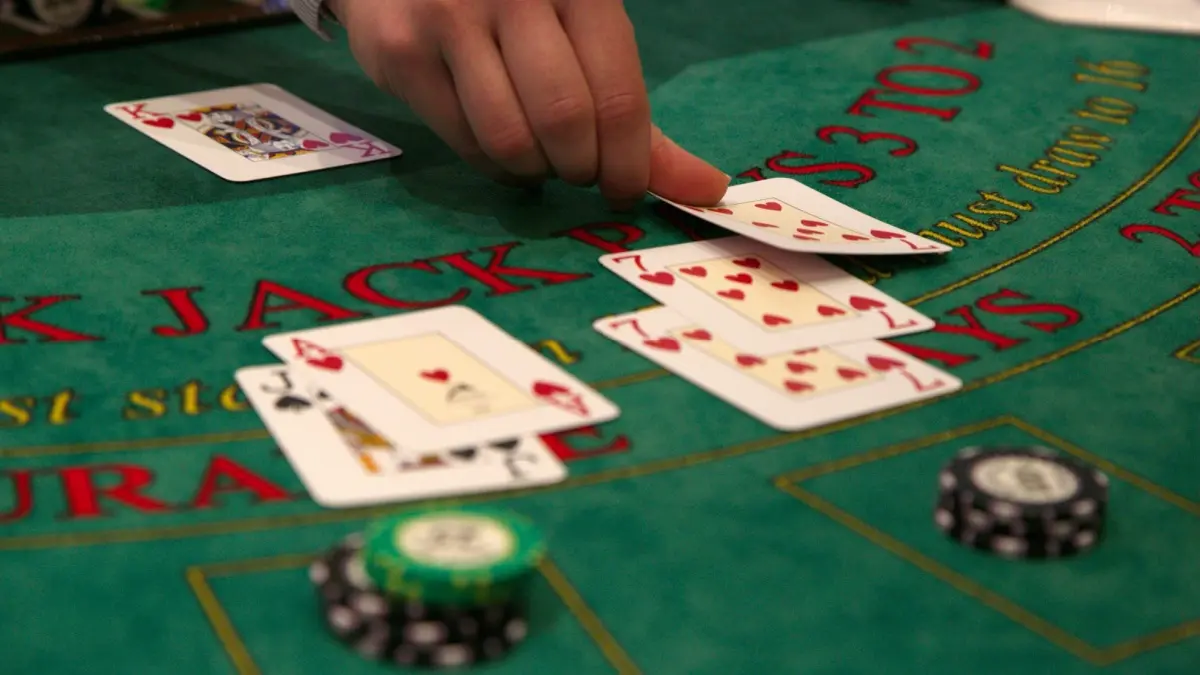
- Read the table rules: Check the deck count, whether the dealer hits or stands on soft 17, and which double, split, and surrender options are available.
- Classify the hand: Identify a pair, a soft total, or a hard total before looking up the decision. An Ace does not automatically make a hand soft; it must count as 11.
- Use the dealer’s visible card: Match that card with your hand and the correct rules. Do not assume the hidden card is a 10.
Hard 17 vs. Soft 17: A Concrete Example
A 10 + 7 and an Ace + 6 can both total 17, but they behave differently. With 10 + 7, a 5 would bust the hand. With Ace + 6, a 5 changes the Ace to 1 and makes a hard 12. Under the rules used here, stand on the hard 17; with the initial Ace + 6, double against dealer 3-6 if allowed, otherwise hit. The dealer’s compulsory soft-17 rule does not dictate your action.
Related:
When Should You Hit or Stand?
The useful question is which action fits your cards and the actual rules. Understanding hard and soft totals, the dealer’s visible card, and the available options gives each decision a clearer basis. A mathematically sound choice can still lose an individual hand, so keep play recreational and make your own decisions.
Explore live blackjack games at McLuck.com, and read each game’s information before starting.
21+. No purchase necessary. Void where prohibited by law. See Terms of Service.
More Fun Facts
Should You Always Split Aces in Blackjack?
Yes, you should almost always split aces in blackjack. According to standard blackjack basic strategy, splitting a pair of aces is the best move…

Can AI Help You Win Blackjack?
No, AI cannot reliably help you win blackjack. An AI blackjack helper may suggest a statistically stronger move, but its answers can be wrong,…

Things to Do on Labor Day Weekend (Fun Ideas for 2026)
Labor Day weekend is the unofficial end of summer. It is a time to relax, enjoy time with family and friends, and make the…
10 Fun Facts About Labor Day in the USA
Long weekend unlocked, finally! Between parades, cookouts, and last-chance summer adventures, Labor Day is all about celebrating the people who keep America ticking. Whether…

Only 9% of New York’s High-Rises Have a 13th Floor – and Asia Is Hiding a Completely Different Number
Superstition isn’t just folklore – it’s quietly reshaping the world’s buildings, floor by floor and room by room. According to a 2020 StreetEasy study,…

12 Fun Things to Do on 4th of July: 2026 Ideas for Every Kind of Celebration
Some holidays come with rules. The 4th of July mostly comes with one: have a good time, however that looks for you. Go big…