

Last modified on:
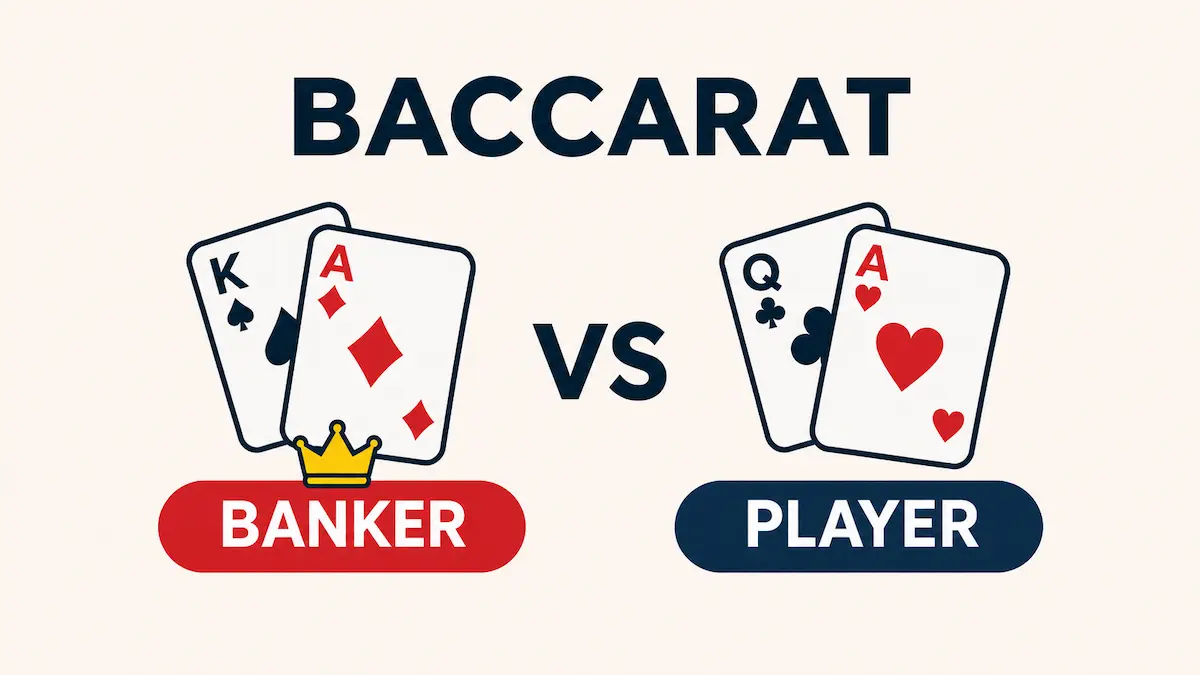
No, you don’t always have to play on the Banker in baccarat. However, the Banker is statistically the better choice in standard baccarat because it has a lower house edge than the Player and Tie selections.
In a standard eight-deck baccarat game, the Banker wins approximately 45.86% of rounds, compared to 44.62% for the Player. Even with the usual 5% commission on Banker winnings, the Banker maintains a lower house edge than Player.
But does that mean you should always choose Banker? Not necessarily. The rules of the game, particularly in no-commission baccarat, can change which option offers the better odds.
Banker vs Player in Baccarat: Which Has Better Odds?
To understand why Banker is generally preferred, let’s compare the three main play options in baccarat.
| Selection | Chance of winning | House edge |
|---|---|---|
| Banker | 45.86% | 1.06% |
| Player | 44.62% | 1.24% |
| Tie | 9.52% | 14.36% |
Rounded figures for standard eight-deck baccarat, including ties, with a 5% Banker commission and an 8:1 Tie return.
The Banker has the lowest house edge at 1.06%, making it the statistically better option over many rounds.
The house edge represents the game’s average mathematical advantage over the player. A lower house edge means a lower expected loss over time, but it does not guarantee a win on any individual round.
For example, a 1.06% house edge means an average expected loss of 1.06 coins for every 100 coins played over a very large number of rounds. Actual results can vary significantly.
Why Does the Banker Have Better Odds in Baccarat?
The Banker’s advantage comes from baccarat’s fixed drawing rules.
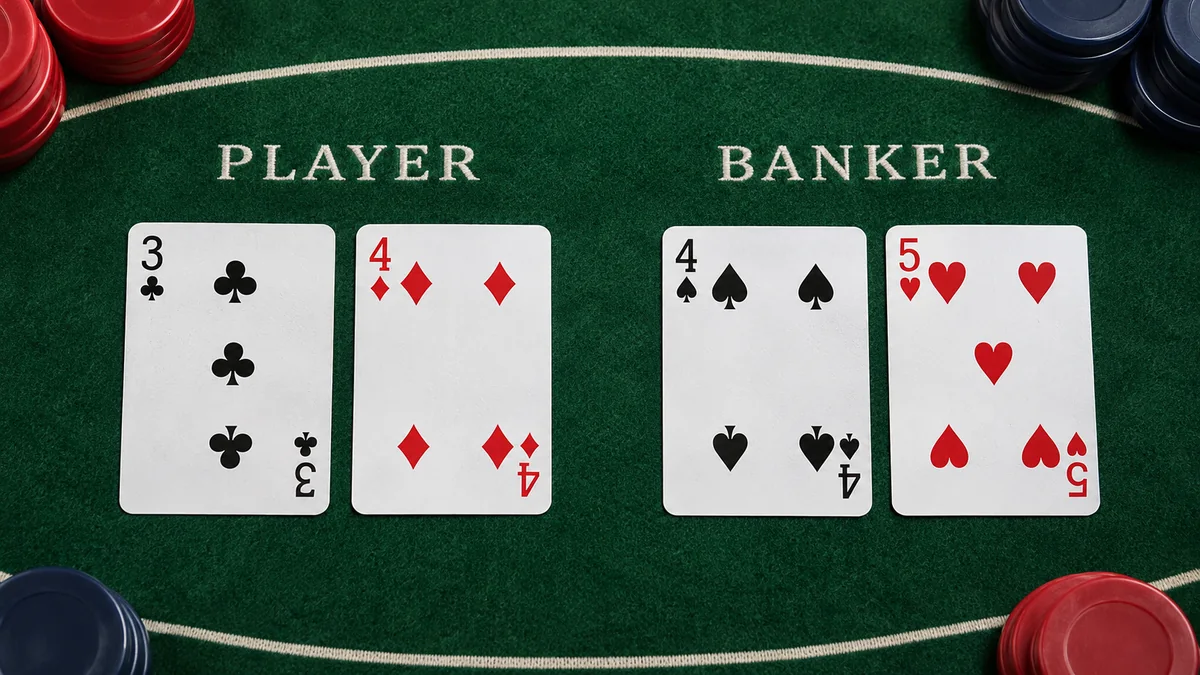
In baccarat, two hands compete: the Player and the Banker. These names simply identify the two hands. You don’t need to be the dealer or act as the Banker to choose that option.
Both hands aim to finish with a total closest to nine. Depending on the initial cards, a third card may be drawn automatically.
Here’s where the difference comes in:
- Player hand: When neither hand has a natural 8 or 9, Player draws a third card when its first two cards total 0-5 and stands on 6 or 7.
- Banker hand: Its automatic drawing rule can depend on its own total and the third card drawn by the Player.
- Natural 8 or 9: If either hand has a natural 8 or 9 on the first two cards, neither hand draws another card.
These different drawing rules produce the Banker’s slightly higher win rate. When Player draws, Banker’s automatic drawing rule also depends on the value of that third card.
Neither hand is controlled by the person playing. The game follows predetermined rules, so choosing Banker doesn’t give you control over the cards.
Does the 5% Banker Commission Affect Your Winnings?
Yes. It reduces Banker winnings, but Banker still has a lower house edge than Player in standard baccarat. The commission does not change which hand wins the round.
A winning Banker play normally returns 1:1 in winnings minus a 5% commission. For example, if you play 100 coins on Banker and win, your net winnings would be 95 coins, plus your original 100 coins returned.
A winning Player play normally returns 1:1 in winnings without that commission.
When Should You Not Always Choose Banker in Baccarat?
Although Banker has better odds in standard baccarat, there are situations where it may not be the better mathematical choice.
1. When Playing Certain No-Commission Baccarat Games
Some no-commission baccarat variations remove the standard 5% Banker commission but introduce different return rules.
One example is an eight-deck Super 6 baccarat game where a winning Banker hand with a total of six returns only 1:2 in winnings instead of the usual 1:1.
This changes the house edge:
| Selection | House edge |
|---|---|
| Banker | 1.46% |
| Player | 1.24% |
Eight-deck Super 6 format with half winnings on winning Banker sixes. Figures are rounded.
In this version, Player has the lower house edge.
However, not every commission-free variation works the same way. For example, in EZ Baccarat, a winning three-card Banker seven makes a Banker selection a push: the original coins are returned without winnings. With eight decks, this gives Banker a house edge of approximately 1.02%.
These two examples show why removing commission does not automatically make Banker the better choice: the replacement return rule matters.
2. When Playing Different Baccarat Variations
Baccarat is available in several formats, including traditional table games, live dealer baccarat and online variations. The delivery format alone does not change the odds; the actual game rules determine the comparison.
Some versions have different returns or commission structures. Additional side plays can also have their own house edges.
The standard Banker advantage may not apply in exactly the same way to every version. Always review the game’s information and return rules.
3. When Playing for Fun Rather Than Optimizing the Odds
The difference between the standard Banker and Player house edges is relatively small.
If you’re simply enjoying baccarat as a card game, you can choose either hand. The important distinction is understanding that Player has a slightly higher house edge under standard rules.
Does Playing Banker Every Round Guarantee a Win?
No. Playing Banker every round does not guarantee a win or eliminate the house edge.
Although Banker wins more often than Player overall, Player can still win consecutive rounds.
For example, you might see five Player wins in a row. That doesn’t mean Banker is guaranteed to win the next round.
Baccarat results are determined by the cards dealt and the game’s rules, not by whether one side has recently been winning or losing.
Similarly, switching between Banker and Player based on previous results doesn’t create a mathematical advantage by itself.
Is Banker Better Than Tie in Baccarat?
Yes. In standard baccarat, Banker is a substantially better mathematical choice than Tie.
The Tie option may look attractive because it typically offers a higher return of 8:1. However, a tie occurs in only about 9.52% of rounds.
At that return, the Tie option has a house edge of approximately 14.36%, compared with just 1.06% for Banker.
This makes Tie considerably less favorable over the long term.
The higher return doesn’t mean the Tie option has a higher chance of winning.
What is the Best Way to Play Banker in Baccarat?
If your goal is to choose the option with the lowest house edge, a simple approach is to understand the game rules before making your selection.
- Check the baccarat variation. Confirm whether you’re playing standard baccarat or a version with different returns.
- Review the Banker commission. Standard baccarat usually applies a 5% commission on Banker wins.
- Compare the house edges. Banker is generally best in standard baccarat, but Player may be better in certain variations.
- Don’t rely on previous results. Winning streaks don’t reliably predict which hand will win next.
- Set limits for your gameplay. Even the option with the lowest house edge can produce losing rounds.
Remember that the Banker’s statistical advantage is small, and no selection method guarantees a particular outcome.
Frequently Asked Questions About Playing Banker in Baccarat
What happens to a Banker selection when the round is a tie?
In standard baccarat, both Banker and Player selections push on a tie: your original coins are returned without winnings. A Tie selection is separate and wins only when the two hands finish with the same total.
Is baccarat a 50/50 game?
Not exactly. If you leave tied rounds out of the calculation, Banker wins about 50.68% of decided rounds and Player wins about 49.32% in the standard eight-deck game. That is a small imbalance, not a prediction that either side will win your next hand.
Can Banker win more hands while you still lose coins?
Yes. Suppose you play 100 coins on Banker in each of 100 non-tied rounds, with the standard 5% commission. If Banker wins 51 rounds and loses 49, you receive 4,845 coins in net winnings on the wins and lose 4,900 on the losses. You finish 55 coins behind despite winning more rounds.
Final Verdict: Should You Always Play on Banker in Baccarat?
Seeing Banker win more often is consistent with standard baccarat’s drawing rules. The useful conclusion is that Banker usually offers a lower expected loss under standard commission rules. It does not mean Banker will win every hand or leave you ahead at the end of a session.
You can choose Player, and ties will still occur. If your aim is to follow the lower house edge, base your selection on the version you’re actually playing: Banker in the standard game, with a fresh comparison when special return rules apply. That gives you a reason for your choice without treating a statistical preference as a promise.
Explore Live Baccarat at McLuck
Ready to put your baccarat knowledge into practice? Explore live baccarat at McLuck, where you can enjoy a real dealer experience from the comfort of your home. Whether you prefer Banker or Player, McLuck offers a fun way to experience live baccarat and other casino-style games.
Related Baccarat Fun Facts:
- Is Baccarat Better Than Blackjack?
- Why Would Baccarat Be James Bond’s Preferred Casino Game?
- The Most Famous Baccarat Players of All Time

More Fun Facts

Things to Do on Labor Day Weekend (Fun Ideas for 2026)
Labor Day weekend is the unofficial end of summer. It is a time to relax, enjoy time with family and friends, and make the…
10 Fun Facts About Labor Day in the USA
Long weekend unlocked, finally! Between parades, cookouts, and last-chance summer adventures, Labor Day is all about celebrating the people who keep America ticking. Whether…

Only 9% of New York’s High-Rises Have a 13th Floor – and Asia Is Hiding a Completely Different Number
Superstition isn’t just folklore – it’s quietly reshaping the world’s buildings, floor by floor and room by room. According to a 2020 StreetEasy study,…

12 Fun Things to Do on 4th of July: 2026 Ideas for Every Kind of Celebration
Some holidays come with rules. The 4th of July mostly comes with one: have a good time, however that looks for you. Go big…

Is It Better to Play Max on Slot Machines?
If you have spent any time around slot players, you have probably heard it: always play max coins, it gives you better odds. It…

How to Get Free Spins at McLuck: A Complete Guide
If you are searching for McLuck free spins, you are likely looking for ways to unlock extra spins and extend your gameplay. This guide…