

Last modified on:
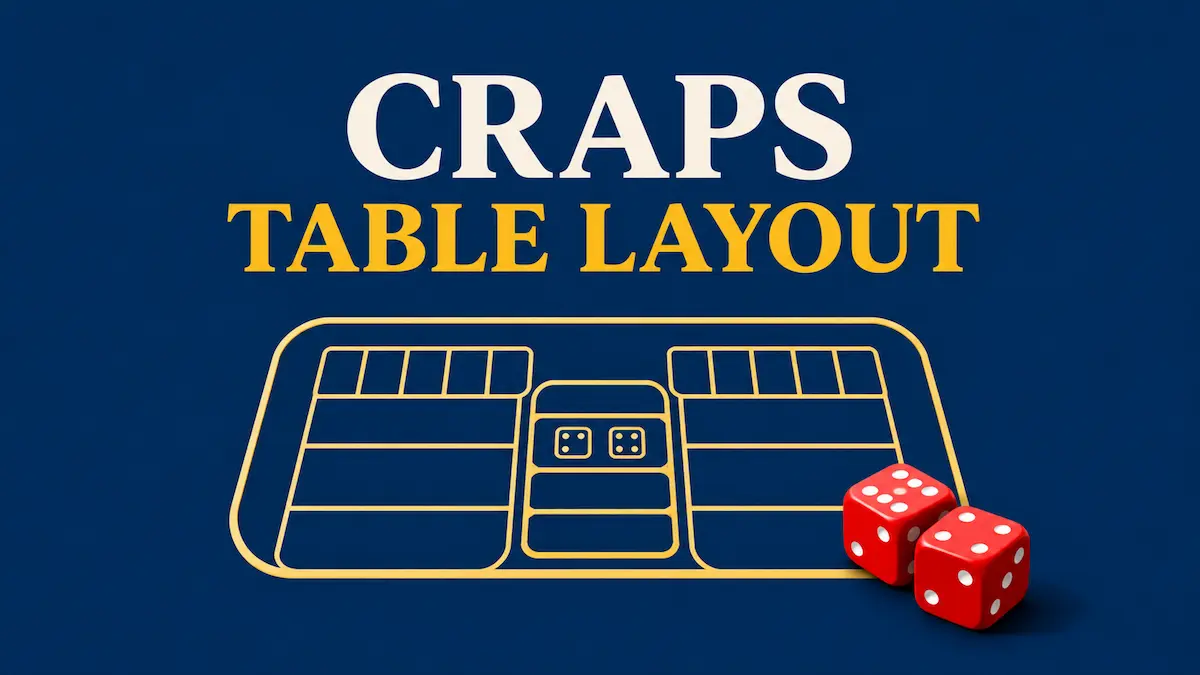
A craps table has several sections where players can place chips on different dice outcomes. The layout may look complicated at first, but most standard tables follow the same arrangement: two mirrored player sections, six numbered boxes, and a shared center area for special selections.
Jump to section
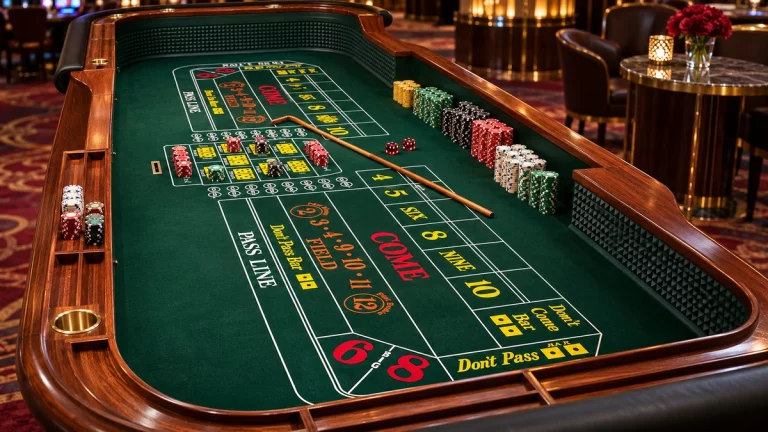
The Pass Line runs around the outer edge of the table, while areas such as Don’t Pass, Come, Field and the numbered boxes appear further inside. A marker labeled ON or OFF indicates whether the shooter has established a point.
This guide explains the craps table layout, what each labeled area means, where different selections belong, and how physical tables compare with online craps interfaces.
How to Read a Craps Table Layout
A traditional casino craps table is elongated, with players positioned along its sides and ends. The printed layout is divided into three main sections:
- Left player section: Contains the main playing areas, including Pass Line, Don’t Pass, Come, Field and the numbered boxes.
- Right player section: Mirrors the same selections for players at the opposite end.
- Center section: Contains special selections, including Hardways and other proposition selections.
The two mirrored sections don’t represent separate games. Everyone at the table follows the same dice results, regardless of where their chips are positioned.
Craps table layout explained at a glance
| Table area | Typical location | Main purpose |
|---|---|---|
| Pass Line | Outer edge nearest players | Main starting selection |
| Don’t Pass Bar | Just inside the Pass Line | Generally backs opposing outcomes to Pass Line |
| Come | Large area within each player section | Starts an individual Come selection |
| Don’t Come Bar | Near the numbered boxes | Starts a Don’t Come selection |
| Field | Between the outer line and Come area | Covers specific totals on the next roll |
| Numbered boxes | Along the upper portion of each player section | Positions for 4, 5, 6, 8, 9 and 10 |
| Big 6 and Big 8 | Corner areas on some tables | Separate selections backing 6 or 8 before 7 |
| Proposition area | Shared center of the table | Hardways, Any 7, Any Craps and other special selections |
Although exact positioning can vary by casino or game provider, these are the main areas you’ll encounter on a standard craps table.
The easiest way to understand the layout is to start at the outer Pass Line and work inward toward the numbered and center sections.
Pass Line and Don’t Pass Areas
The Pass Line and Don’t Pass Bar are two of the most recognizable sections of a craps table.
Both relate to the main come-out and point sequence, but they represent opposing outcomes.
Where is the Pass Line on a craps table?
The Pass Line is the large marked strip that runs around the outer edge of each player section, usually closest to the player.
On a standard craps table, players place their Pass Line chips in this area before the come-out roll.
The selection wins if the opening roll totals 7 or 11. If a point is established, it wins when that number is repeated before a 7.
Because the Pass Line follows the main round, it is a useful reference point when learning how the table operates.
Where is the Don’t Pass Bar?
The Don’t Pass Bar normally appears immediately inside the Pass Line, often as a narrower marked strip.
It is commonly labeled DON’T PASS BAR, sometimes accompanied by a reference to 12.
Unlike the Pass Line, Don’t Pass backs a 7 appearing before the established point. It also follows different conditions on the come-out roll.
Some tables display the words Bar 12, indicating that a come-out total of 12 is a push for Don’t Pass rather than a win. Under this rule, the selection neither wins nor loses.
The exact placement of the label may differ, but the Don’t Pass area is generally easy to identify because it runs close to the Pass Line.
For the full conditions associated with both sections, read our craps rules guide.
Come and Don’t Come Areas
Farther inside the table are the Come and Don’t Come sections. These areas are used for selections that begin after a main table point has been established.
What is the Come area?
The Come area is usually a large rectangular section marked COME.
It occupies a prominent position within each player section, near the Field and numbered boxes.
A Come selection starts in this area. If the next dice total establishes an individual Come point, the dealer moves the chips to the relevant numbered box.
For example, if a Come selection establishes 5 as its point, the chips are moved to the 5 position.
The selection then follows that number independently of the main table point.
This is why you may see several Come selections positioned on different numbers at the same time.
What is the Don’t Come Bar?
The Don’t Come Bar is typically a smaller section close to the numbered boxes, often at one end of the numbered row.
Don’t Come selections start here before moving to their individual number positions when a Don’t Come point is established.
The key difference between the two sections is the outcome they represent.
Come selections generally back their individual number appearing before a 7, while Don’t Come selections back a 7 appearing before that number.
Both use the numbered areas to track established selections, but their chip placement is distinguished by the dealer or the table’s interface.
The Numbered Areas: 4, 5, 6, 8, 9 and 10
One of the most important parts of the craps table layout is the row containing six numbered boxes:
4, 5, 6, 8, 9 and 10
These numbers represent the standard point totals and provide positions for several types of selections.
You may notice that Six and Nine are written as words on some traditional tables rather than displayed as numerals. They still identify the dice totals 6 and 9.
What are the numbered boxes used for?
The numbered section serves several purposes.
| Use | How the numbered area works |
|---|---|
| Table point | The ON marker identifies the current point number |
| Place selections | The dealer positions chips on the selected number |
| Other number-based selections | Chips are positioned using the table’s placement conventions |
| Come selections | Chips move to the number established as the Come point |
| Don’t Come selections | Chips are positioned to identify the established Don’t Come point |
On physical tables, the dealer normally handles chips associated with these numbered positions.
The exact placement of a chip within or around a number box helps distinguish the selection type and player.
For example, a Come selection on 6 and a Place selection on 6 aren’t automatically the same thing, even though they share the same number.
Why is 7 missing from the numbered boxes?
The standard numbered boxes exclude 7 because it cannot become a table point in traditional craps.
A 7 either resolves an opening Pass Line selection immediately or causes the Pass Line to lose when it appears before an established point.
However, 7 may still be displayed elsewhere on the table, particularly in the proposition area for selections such as Any 7.
The numbers 2, 3, 11 and 12 are also absent from the standard point row. These totals are handled differently on the come-out roll.
Our craps variations guide explains how Crapless Craps changes which totals can become points.
The Field Area on a Craps Table
The Field is a prominently labeled section containing several dice totals.
On standard craps tables, the Field covers:
2, 3, 4, 9, 10, 11 and 12.
A Field selection applies to the next roll only. If the dice produce one of those totals, the selection wins under the table’s stated reward conditions.
If the dice total 5, 6, 7 or 8, the Field selection loses.
What do the numbers printed in the Field mean?
The printed numbers tell players which dice totals are included in the Field selection.
However, not every number necessarily carries the same reward ratio.
For example, 2 and 12 are often highlighted with circles or additional text indicating a different reward. Depending on the table, one or both may receive an enhanced ratio.
The layout should identify those differences, either directly within the Field area or in the game’s reward information.
Is the Field the same as the numbered boxes?
No, although some numbers appear in both areas, they serve different purposes.
A Field selection covers multiple totals and resolves after one roll. A Place selection in a numbered box backs a specific total appearing before a 7 and can remain active across multiple rolls.
For example, 4 appears in both the Field and the numbered section, but a Field selection and a Place selection on 4 are not equivalent.
This distinction is important when reading the craps table because the same number can appear in multiple areas without representing the same conditions.
Proposition Selections in the Center of the Craps Table
The center of a traditional craps table contains the proposition playing area, which is shared by players on both sides.
It typically has more labels, dice illustrations and reward ratios than the outer sections.
These selections often focus on particular totals or dice combinations.
Common center-table selections
| Label | What it represents |
|---|---|
| Any 7 | A total of 7 on the next roll |
| Any Craps | A total of 2, 3 or 12 on the next roll |
| Aces | A total of 2, made with 1 + 1 |
| Ace-Deuce | A total of 3, made with 1 + 2 |
| Eleven | A total of 11 |
| Twelve | A total of 12, made with 6 + 6 |
| Horn | A combination of selections covering 2, 3, 11 and 12 |
| Hardways | Selected even totals made with matching dice |
| Hop | A particular dice combination on the next roll |
Not every table offers the same proposition selections.
Some tables have additional combinations, while online versions may organize these choices into separate menus.
What is the Hardways section?
The Hardways section usually appears within the center proposition area.
It covers four even-numbered totals made using matching dice:
- Hard 4: 2 + 2
- Hard 6: 3 + 3
- Hard 8: 4 + 4
- Hard 10: 5 + 5
For example, a Hard 6 selection backs the dice producing 3 + 3 before an easy 6 or a 7 appears.
An easy 6 is a total of 6 made with unequal dice, such as 4 + 2 or 5 + 1.
Unlike many other proposition selections, Hardways are generally multi-roll selections, meaning they can remain active beyond the next roll.
Who handles chips in the center area?
At traditional casino craps tables, center proposition selections are generally handled by the stickperson.
Players communicate the relevant selection to the table crew rather than reaching across the table to place chips directly in the center.
The stickperson also handles the dice using a long stick.
In digital games, these functions are represented by selectable areas or controls, so there is no need to interact with a physical dealer.
What Does the ON/OFF Marker Mean in Craps?
The ON/OFF marker is one of the most useful indicators on a craps table.
Also known as the puck, it shows whether a main table point is active.
| Marker | Meaning | What to look for |
|---|---|---|
| OFF | No table point is established | The next roll is a come-out roll |
| ON | A table point is active | The marker identifies the point number |
What does OFF mean?
When the marker displays OFF, no main table point has been established.
The next roll begins a new come-out sequence.
At a physical table, the OFF puck is normally kept in a designated position near the numbered section rather than marking a specific point.
What does ON mean?
Once a point is established, the dealer turns the marker to ON and places it over the corresponding number.
For example, if the come-out roll totals 8, the puck displays ON above the number 8.
This tells players that 8 is the active table point.
The marker returns to OFF after the main point sequence ends.
Does the OFF marker mean every selection has ended?
No. The puck tracks the main table point, not every individual selection.
Come and Don’t Come selections can have their own established points that remain active even when the table marker returns to OFF.
Similarly, a selection that has been switched off isn’t necessarily removed from the table.
The puck should therefore be read as a guide to the current table phase rather than a complete record of every active selection.
How to Tell Where Chips Belong on the Table
A craps table can display several selections associated with the same dice total.
That makes chip placement important.
At a physical table, the location of chips often identifies both the player and the selection type.
For instance:
- Pass Line chips are placed in the outer Pass Line area.
- Don’t Pass chips belong in the adjacent Don’t Pass Bar.
- Come selections begin in the Come area and may later move to a number.
- Field chips are placed within the Field section.
- Place selections are positioned by the dealer on the relevant numbered area.
- Additional odds chips are placed in relation to an existing line selection, following the table’s placement conventions.
A chip being close to a numbered box doesn’t necessarily mean it is a Place selection. It might represent a Come, Don’t Come, Lay or another number-based option.
When using a physical table, let the dealer manage the areas that require dealer placement.
For online games, check the selected playing area and the displayed confirmation before the next roll.
If you’re new to the sequence of placing and following a selection, our how to play craps guide walks through a complete example.
How Is an Online Craps Table Layout Different?
An online craps table generally preserves the important playing areas of the selected ruleset but adapts them to a digital screen.
Rather than displaying the full length of a physical craps table, an online version may present a simplified or single-sided view.
The Pass Line, numbered areas, Field and proposition selections can be displayed as interactive sections.
Physical vs online craps table layout
| Feature | Traditional table | Online table |
|---|---|---|
| Main playing areas | Printed on casino felt | Displayed digitally |
| Pass Line | Along the physical table edge | Selectable area on screen |
| Point marker | Physical ON/OFF puck | Digital ON/OFF indicator |
| Chip placement | Player or dealer, depending on selection | Digital chip controls |
| Numbered boxes | Managed by the table crew | Managed by game interface |
| Dice | Physically rolled by shooter | May be automated or digitally generated |
| Selection timing | Managed by dealers | May use a visible timer |
The exact appearance depends on the game provider, interface and chosen variation.
What does the Bubble Craps layout look like?
Bubble Craps combines physical dice with a digital playing interface.
Instead of a player throwing dice across a traditional table, an automated mechanism rolls the dice inside an enclosure.
McLuck’s Iconic21 Bubble Craps includes a digital playing area with drag-and-drop chip controls, a selection timer and an ON/OFF indicator.
These controls let players identify the current phase and follow the dice results without using a full-sized physical table.
Bubble Crapless Craps uses the same broad automated-dice concept but changes the standard point structure. Additional totals, including 2, 3, 11 and 12, can become points.
This means its numbered layout and available selections can differ from a standard craps table. Our introduction to Bubble Craps and Bubble Crapless Craps takes a closer look at both formats.
You can compare both formats in our craps variations guide.
Frequently Asked Questions About Craps Table Layouts
Why are numbers repeated on a craps table?
Traditional craps tables have two mirrored player sections, so the six standard point numbers are displayed on both sides. Players can use the section nearest them while participating in the same dice game.
What is the most important area on a craps table for beginners?
The Pass Line is a useful starting point because it follows the game’s main come-out and point sequence. The ON/OFF marker and numbered boxes are also important for understanding the current round phase.
What do Six and Nine mean on a craps table?
Some traditional layouts label these numbered boxes Six and Nine rather than using numerals. They represent dice totals of 6 and 9 and belong to the same point-number row as 4, 5, 8 and 10.
Are the Field and Come areas the same?
No, the Field covers specific totals on the next roll only. The Come area is used to begin a selection that may establish its own point and continue across multiple rolls.
What does the ON/OFF indicator mean on an online craps table?
OFF means no table point is active, while ON means a point has been established. The active point number is usually highlighted on the digital layout.
Do all craps tables have the same layout?
Standard tables share many recognizable sections, but their labels, optional selections and reward information can vary. Crapless Craps also changes the point structure, while digital versions may rearrange playing areas to suit the screen.
Related Craps Guides
- How to Play Craps
- Craps Variations
- Live Craps
Explore Craps Tables at McLuck
Understanding the craps table layout helps you recognize the major playing areas, follow the ON/OFF marker and distinguish between selections that may look similar.
Before starting a new game, check the table’s available options and rules, particularly when switching between standard craps and Crapless Craps.
Ready to put the layout into practice? Explore Bubble Craps at McLuck, find the Pass Line and follow the point marker as the dice roll.
For a broader introduction to the game, including its rules, odds, rewards and variations, return to our complete craps guide.
More Casino Guides

Craps Strategy: Best Options, House Edge and Playing Systems
The best craps strategy depends on what you want to achieve, but understanding the house edge is essential. While you cannot control the outcome…
Craps Odds: Dice Probabilities and House Edge
Craps odds become easier to understand once you separate three different ideas: the probability of a dice result, the reward offered for a successful…

Craps Rewards: Ratios and Wintable Examples
Understanding craps rewards starts with one distinction: the reward you gain is different from the total amount returned after a successful selection. A 1:1…

Craps Tips for Beginners: Avoid Common Mistakes
Learning craps involves more than remembering which dice totals win. You also need to recognize the current phase, know what your chips represent and…
How to Play Craps: A Step-by-Step Beginner Guide
Learning how to play craps is easier than the busy table layout might suggest. Although the game offers several playing options, the basic gameplay…
Craps Rules: Come-Out Rolls, Points and Results
Standard craps rules depend on the stage of play. On a Pass Line come-out roll, 7 or 11 wins, 2, 3 or 12 loses,…